World
Gazans resort to makeshift toilets amid sanitation crisis in Strip’s vast tent camps

KHAN YOUNIS, Gaza Strip (AP) — In their bare-bones tent in southern Gaza, Mostafa Shaaban built his family’s makeshift toilet behind a curtain in a corner. He dug a shallow pit in the sandy soil, poured a concrete slab around it, fixed a bottomless bucket over the hole, then topped it off with a battered, plastic toilet seat.
It reeks with a foul odor and buzzes with flies and mosquitoes only a few feet from where they sleep and prepare meals. Every week, Shaaban has to dig out the sewage sludge from the pit. But at least it’s more private than the fetid communal latrines used by hundreds of other people in their sprawling tent camp.
“I did not want the kids and my wife to use any public toilet. It is humiliating,” said the 38-year-old Shaaban, who was driven from his home city of Rafah two years ago during the war between Israel and Hamas, and eventually settled in a tent camp in Khan Younis.
“The situation is revolting,” he said of having the toilet inside the tent, “but at least it has more dignity.”
There is not a single proper toilet across the vast tent cities housing most of Gaza’s 1.7 million Palestinians left homeless by the war. Displaced families have largely been left to dig their own latrines, some shared by extended families.
At communal camp toilets, men, women, and children wait in long lines, then do their business behind a thin cloth or sheet of metal separating them from the crowd of strangers outside. Women fear walking to the communal toilets at night.
The result is a hygienic nightmare as horrible smells drift among the tightly packed tents and pools of sewage collect from leaking cesspits or from people dumping the contents of their latrines. More than 80 percent of the sewage pumping stations in Gaza have collapsed from Israeli strikes and offensives over the past 2.5 years, rights groups have said.
Some aid groups have carried out projects to improve family toilets, but they have been small-scale, and supplies are limited. It remains far from certain when the reconstruction of Gaza will begin.
The US-backed official overseeing the ceasefire in place since October has blamed Hamas for holding up the process by failing to reach an agreement on disarmament.
The war in Gaza was sparked by the Hamas-led massacre in southern Israel on October 7, 2023. The fighting has left much of Gaza in ruins as Israel fought a terror group that both ruled the Strip and was deeply embedded in civilian areas.
Almost all of Gaza’s residents are now crowded into the approximately 40 percent of the Strip still controlled by Hamas after the truce.
“It’s the most basic right. Making a toilet is more important than food and water, because you see the insects everywhere, the smell covers everyone,” said Shaaban’s wife, Iman Mansour, who is pregnant with their third child. “We want something clean.”
Building a latrine is not cheap. Shaaban said it took him a long time to set up his toilet because he had to buy the pipe for the latrine hole and the concrete to seal around it. The concrete often crumbles, so he has to buy more when he can afford it.
A porcelain toilet seat runs from 1,700 to 2,000 shekels ($500 to $680), out of reach for most families. In any case, a seat in a tent latrine would simply be set over the hole to provide a more comfortable seat, but it would still be unable to flush. So people improvise, using chairs or buckets with the bottom knocked out, or just squat over the hole.
One vendor working out of a tent in Khan Younis makes metal sheets to fit around a latrine hole that are at least easier to clean, selling them for 100 shekels ($34).
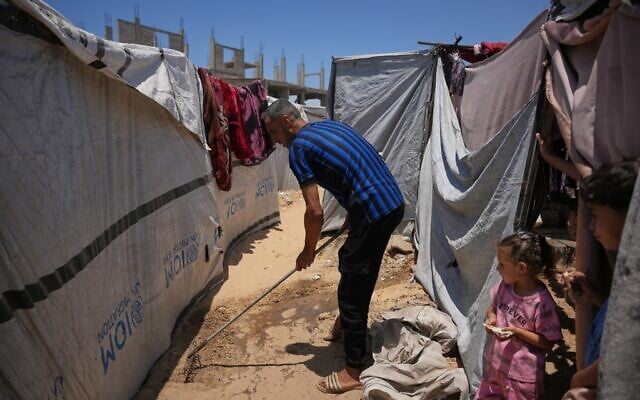
In one of the camps around Khan Younis, Khaled Kollab laboriously cleared the sewage drain and pools of untreated wastewater next to his tent. His tent latrine is a simple squat toilet with no seat, which he said was made of ramshackle supplies because he couldn’t afford anything better. His 3-year-old daughter, Sila, stood nearby, her body covered in lesions.
“You go into this toilet and feel humiliation and shame,” Kollab said.
Times of Israel staff contributed to this report.