World
Fuel prices didn’t skyrocket before. Here’s why they could shoot up this time

SINGAPORE – As tensions flare in the Hormuz Strait again, there are warnings the oil shock that never came could be around the corner.
Is this another round of crying wolf? Much depends on how the renewed hostilities between the US and Iran will pan out over the next few weeks, and demand from China – the world’s largest consumer of oil.
If the worst happens, then yes, oil can go up to more than US$100 (S$129) a barrel, analysts say.
Before the United States and Israel attacked Iran on Feb 28, about 20 million barrels of crude oil and oil products were passing through the Strait of Hormuz each day, or a fifth of global consumption.
So it was not surprising that when Iran blocked the Strait, many predicted an oil shock that could debilitate the world economy –particularly in Asia where much of that oil was bound.
But after the oil price touched US$126 a barrel in late April, it soon retreated. Brent futures settled at pre-war levels of around US$70 in early July, when the war seemed on track to wind down following an interim peace agreement between the US and Iran.
The doomsday of skyrocketing fuel prices did not materialise. Then, hostilities resumed.
Since early July, the US has been striking Iranian military sites while Iran has attacked ships in the Strait of Hormuz and targeted US bases in Gulf states. The US reimposed a blockade on Iranian ports on Tuesday (Jul 14), deepening the crisis.
Brent futures climbed to above US$80, but are nowhere near the earlier predictions of US$100 a barrel or more.
How long can buffers last?
Although oil supply through the Strait has contracted significantly since March, there were a few buffers that helped cushion the blow in the past few months.
The question is, how long can these last?
In the days before the war, there was oversupply of about 2 million barrels a day, providing a ‘head start’, the International Monetary Fund (IMF) said in a report on July 15.
The world’s top crude oil importer, China had an outsized role in swaying global oil prices. Since March 2026, it has slashed oil purchases significantly, contributing to reduced global demand. In June, Chinese crude imports fell to a near decade low of about 7 million barrels per day, compared to a record 11.6 million in 2025.
Analysts have attributed this reduction to rising electric vehicle adoption, the use of massive stockpiles and the maturation of alternative fuel sources, such as the increased use of coal in chemical production.
Production outside the Gulf, led by the United States, also rose by nearly 2 million barrels a day above 2025 levels, IMF said.
Importantly, governments and international bodies drew heavily on emergency stockpiles. The International Energy Agency (IEA) coordinated the release of 400 million barrels of petroleum, and the United States released millions of barrels from strategic reserves.
But now, as attacks in the Gulf by the US and Iran widen, some analysts are sounding the alarm again. The IMF warned that while the factors above helped cushion the initial blow, “much of that room has now been used up”.
One obvious difference then and now is that spare capacity has been used up and global strategic and commercial stocks are lower now than when the war began.
Vandana Hari, CEO of London-based Vanda Insights, said “what has saved the world in the past four months might not be able to save the world going forward”.
“The IEA released 400 million barrels hoping it was a short-term supply shock. But they are not designed or capable of countering a shock that goes on for six to eight months. The US Strategic Petroleum Reserve (SPR) is closing in on 300 million barrels, which is the optional minimum for these stockpiles, at a 43-year low,” Hari said.
One big question is this: Can China continue to keep its oil imports down, or will it start to replenish its reserves? Experts who believe the latter expect prices to continue to rise.
Veteran oil expert Bob McNally, founder and president of Rapidan Energy and a former White House energy adviser said markets are “too complacent” about a smooth restart of Gulf oil production and Hormuz flow normalisation.
“US exports will not be able to fill the entire gap caused by the Hormuz disruption, especially given strong US domestic demand and already-high refinery utilisation rates,” he said.
“Moreover, China is returning to the crude market to buy for its SPR and export refineries.”
Iran targets shuttle runs
Even when Iran declared the Strait of Hormuz closed, oil from the Gulf was “leaking” through alternative routes such as Saudi Arabia’s east-west pipeline and dark transits that hugged the Omani coast under US guidance.
A significant amount of Gulf oil had been sent to the Red Sea through a Saudi pipeline to the Red Sea port of Yanbu. This week, however, Iran has asked Yemen’s Houthi movement to stand ready to close the Red Sea oil route if the US strikes Iranian power infrastructure, Reuters reported on July 16.
Traders had also been seeking alternative ways to ship oil out of the Gulf by traversing the southern coast closer to Oman, and using “shuttle runs” – short trips from Gulf terminals to ports just outside the Strait of Hormuz. Shuttle runs had freed massive amounts of oil in the past few months, according to the Wall Street Journal.
But these options are far riskier since the US-Iran agreement collapsed, with Iran becoming more vigilant over “shuttle runs”, Lloyd’s List Asia-Pacific editor Cichen Shen told The Straits Times.
Iran had struck several commercial ships on July 14 that were transferring oil from Gulf producers to vessels on the other side of the Strait, including two that had been part of the Hormuz shuttle service for months.
“So I assume the operators would be more cautious and the exports will likely drop temporarily at least until the next de-escalation,” said Shen.
The IEA has also expressed concern with the agency’s executive director Fatih Birol calling the Iran war the “worst energy disruption in history”.
“Oil security is still a critical issue,” Birol told a Council on Foreign Relations event on July 16. “We should be worried, and I am worried, if the situation does not improve in the next few weeks.”
Asia would be hardest hit, he warned.
“It is mainly Asia, because Asia was getting 80 to 90 per cent of this energy from the Strait of Hormuz,” he said.
Diversifying energy sources
However, since the Iran war began, Asian countries have quickly pivoted to other fuel sources, and taken steps to reduce reliance on Gulf oil.
The world’s third-largest energy consumer, India, which imports more than 80 per cent of its crude from the Gulf via the Strait of Hormuz, reshaped its energy security strategy, avoiding a full-blown crisis.
As the war dragged on, state-owned refiners diversified crude purchases beyond West Asia, increased spot-market buying, and expanded imports from Russia, the US and West Africa to secure its energy needs.
“India was able to maximise Russian crude oil purchases in the second quarter of 2026 (April to June) especially after the US issued a sanctions waiver, allowing countries to purchase Russian oil in March,” said Mr Hari of Vanda Insights.
Trade data published on July 13 by India’s Ministry of Commerce and Industry shows that imports of petroleum products from Russia grew 23.11 per cent in April-June 2026 to US$60.62 billion compared to last year.
“India can continue to buy Russian crude and step up imports from the US and other far-flung countries, but it might not be possible to do so on a sustained basis as prices increase and inventories the world over are depleted. Russian refiners have also been severely hobbled by the Ukraine strikes,” Hari told ST, referring to Ukrainian attacks on Russian refineries and shipping.
Likewise, other Asian countries have found alternative ways to sate their economies’ thirst for oil.
For many, this has meant turning to multiple sources including Russia, the US, Malaysia, Brunei, Australia and African sources including Angola, Nigeria and Algeria. South Korea and Japan have diversified their crude streams from as far as Mexico, Ecuador, Azerbaijan, Venezuela and Canada, on top of increased purchases of US crudes.
Malaysia’s Senior Director of Economics and Finance in the Prime Minister’s Office, Nurhisham Hussein, told The Straits Times that a huge factor in the oil price surge after the US-Iran conflict broke out was a “big scramble and panic buying” for supply but most markets have now found alternatives.
Although more than two-thirds of Malaysia’s crude imports – or 40 per cent of its total demand – are sourced from Hormuz-linked producers, state oil giant Petronas secured additional supply from West Africa and Latin America in March, and Prime Minister Anwar Ibrahim has assured that supplies from Russia remain secure.
There are also some, like Indonesia, who produce their own oil and have upped production.
“When Middle East supply tightened, the government funnelled all domestic output to local refineries and pushed utilisation to about 80 per cent,” said Fabby Tumiwa, chief executive of the Jakarta-based Institute for Essential Services Reform.
Indonesia also moved swiftly to lift output from the overseas oil fields of state-owned Pertamina, said Yusri Usman, executive director of the Centre of Energy and Resources Indonesia.
‘Ruthlessly adaptable’
South Korea is the world’s fifth-largest oil refining nation, with a combined crude refining capacity of about 3.2 million barrels per day. This capacity helped avert domestic fuel shortages, even though it remains exposed to volatile global oil prices, said Associate Professor Kim In-wook of Sungkyunkwan University in Seoul.
“Countries with excess refining capacity such as South Korea are primarily exposed to volatility in crude oil prices. But countries without such a capacity face an added challenge of securing refined petroleum products in times of disruption,” he told The Straits Times.
South Korea is also turning to nuclear power. In April, it officially restarted a nuclear reactor for a 10-year lifespan extension, and is looking to expedite the restarting of six other reactors that were down for routine maintenance to secure the national power supply.
For Australia, which relies on Asian refineries for oil products, the “nightmare scenario” was not about crude oil, said energy expert Lurion De Mello, from Macquarie University.
“It was about the refined petrol, diesel and jet fuel that arrives by tanker every day from Asia’s refining hubs… Australia’s fuel supplies held not because the crisis was mild, but because the Asian refining network that serves it proved ruthlessly adaptable.”
Japanese oil refiners, for instance, have said they will diversify supply sources while exploring pipeline expansion projects in the Middle East that bypass the Strait of Hormuz, Reuters said on July 15.
Shunichi Kito, the president of Petroleum Association of Japan, told reporters on July 15: “It is of the utmost importance to establish a viable alternative to crude oil transported through the Strait of Hormuz, rather than simply replacing crude oil sourced from the Middle East.”
Most countries are still sitting on some reserves. Thailand still has about 110 days worth of oil reserves including the amount enroute to the kingdom.
“Thailand is better prepared this time and I think we know all the risks now. Because we know how to diversify, we know how to adapt ourselves and people are not panicking now,” Ruengsak Thitiratsakul, Advisor of the Petroleum and Energy Institute of Thailand told The Straits Times.
Japan and South Korea are well stocked, each with about 200 days of supply, more than double the International Energy Agency’s minimum stockholding requirement of 90 days.
Not all countries are as well-insulated. June Goh, a senior oil market analyst at Sparta Commodities, a global energy market intelligence firm, said that the nations more likely to be affected by a prolonged closure of the Strait are those that have limited refining capacity and require product imports to meet their energy needs, such as Bangladesh, Cambodia and the Philippines.
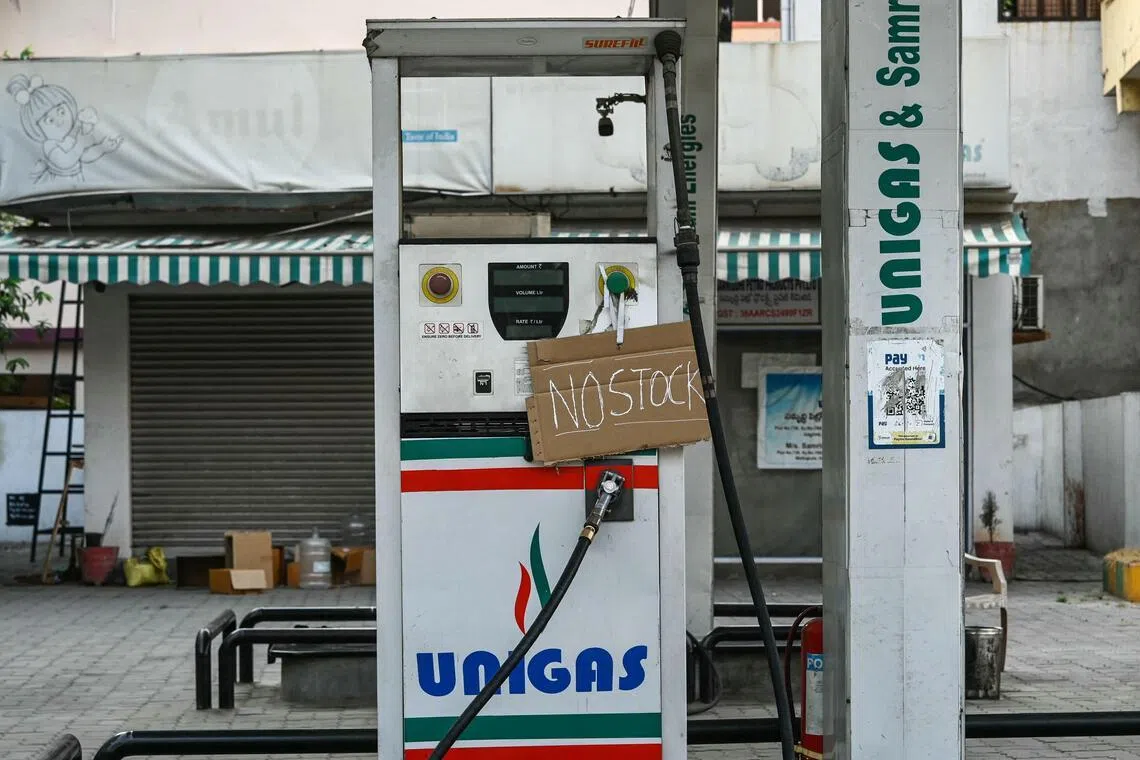
The Philippines, the first country in the region to declare a national energy emergency over the Iran war, never ran out of fuel. But analysts say that owes less to government intervention than to a global supply crunch that simply never materialised.
Mr Noel Leyco, chief economist at Credit Rating and Investors Services Philippines, said: “I think the Philippines basically got lucky.”
“They can only tap into what was available in the world market,” adding that the country’s roughly 45-day stock was never seriously drawn down.
Mr Leyco warned that the government’s June declaration that the worst is over no longer holds.
Trouble ahead
“The price of oil per barrel has already gone up 15 per cent since the resumption of the hostilities,” he said. “Iran is retaliating in a more widespread manner… We’re definitely in for bigger trouble in the next few days”.
The war in the Persian Gulf is not the only crisis disrupting energy markets. Diesel supplies face a “double whammy” as Russia bans diesel exports after Ukrainian drone attacks on its refineries, said Sparta’s Goh.
“Diesel consumers are hurting, and that means everyone hurts down the line – we all rely on freight in some way,” said Chris Newton from the International Crisis Group.
But not everyone thinks that the worst will happen.
“We expect an eventual calming of the hostilities,” said Norbert Rücker, Head of Economics and Next Generation Research at Julius Baer in Zurich. “Of course, the situation is fluid and such conflicts can get out of hand when hot-headed politics prevail. But we see a below 15 per cent chance of serious re-escalation that revives economic concerns.”
What’s clear is that the months-long crisis has already altered energy supply flows around the world and governments worldwide are taking steps to reduce their reliance on this chokepoint held hostage by a hardline regime.
The risk of the conflict bubbling over into all-out war is still real, but regardless of the outcome of the Iran war, the world is turning elsewhere for its fuel.
Additional reporting by Kok Yufeng, Rohini Mohan in Bengaluru, Bhagyashree Garekar in Philadelphia, Shannon Teoh in Kuala Lumpur, Wahyudi Soeriaatmadja in Jakarta, May Wong in Bangkok, Jonathan Pearlman in Sydney, Wendy Teo in Seoul, Mara Cepeda in Manila and Walter Sim in Tokyo.