Trends
FG Launches $1bn HOPE Programme To Move Vulnerable Nigerians To Self-Reliance

ABUJA— THE Federal Government on Wednesday, launched a $1 billion social protection programme designed to shift vulnerable Nigerians from temporary relief to lasting economic empowerment and self‑reliance.
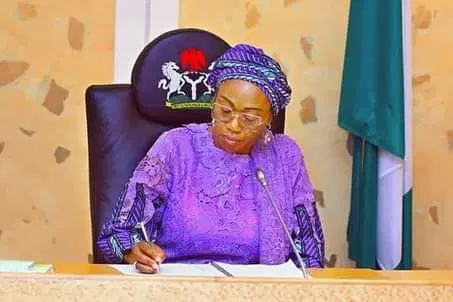
In a keynote address with the theme: “From Palliatives to Pathways,” the First Lady, Senator Oluremi Tinubu, said the initiatives represented an important step towards improving the lives of vulnerable individuals, families and communities across the country.
Other initiatives unveiled were the One-Humanitarian-One Poverty Response System (OHOPRS), the Emergency Cash Transfer Programme, the Federal Ministry of Humanitarian Affairs and Poverty Reduction Ministerial Blueprint and the Humanity First Magazine.
Senator Oluremi Tinubu said although the five initiatives perform different functions, they share the common objective of improving the wellbeing of Nigerians, particularly those facing economic and social vulnerabilities.
The President wife explained that the programmes were particularly significant against the backdrop of the far-reaching economic reforms being implemented by the administration of President Bola Ahmed Tinubu to strengthen the economy and establish a foundation for sustainable growth and shared prosperity.
According to her, while the reforms continue to take effect, the government and other stakeholders must recognise that many Nigerian families still face challenges and require support.
“Under the leadership of His Excellency, President Bola Ahmed Tinubu, GCFR, our nation is implementing far-reaching reforms to strengthen the economy, lay a solid foundation for sustainable growth, and shared prosperity.
“As these reforms continue to take effect, we must recognize that, given the size of our population and available resources, many families still face challenges and require our collective support,” she said.
The First Lady described HOPE-SP as an important intervention designed to strengthen the process of identifying vulnerable households, understanding their peculiar needs and providing appropriate assistance.
She explained that rather than merely providing temporary relief, the programme would combine immediate stabilisation assistance with interventions capable of putting affected households on a path towards recovery and economic independence.
“The first initiative, the Household Prosperity and Empowerment Social Protection Project, is an important step toward strengthening how to identify and respond to vulnerable households facing various challenges by listening to their specific needs before taking action.
“It is designed to provide immediate stabilization assistance while placing the households on a pathway to recovery, empowerment and self-reliance,” she said.
On the One-Humanitarian-One Poverty Response System, the First Lady said the platform would provide a coordinated national mechanism for responding to humanitarian emergencies, delivering social protection and tackling poverty.
She said the system was expected to eliminate duplication among government interventions while maintaining unified national registries through which poor and vulnerable households could be identified, supported and tracked as they progress towards prosperity.
Mrs Tinubu also said the Emergency Cash Transfer Programme would provide rapid financial assistance to households confronted by economic shocks, while the Ministerial Blueprint would translate the humanitarian and poverty reduction priorities of the Renewed Hope Agenda into measurable actions.
According to her, effective planning and accountability must remain central to the delivery of government services to Nigerians.
She also described the Humanity First Magazine as a significant component of the initiatives because it would document the experiences of citizens whose lives have been transformed through government interventions.
The First Lady commended the Minister of Humanitarian Affairs and Poverty Reduction, Dr Bernard Doro, and officials of the ministry for developing the initiatives.
She said the programmes were capable of transforming Nigeria’s humanitarian interventions from temporary assistance into sustainable mechanisms for building resilience and prosperity.
“I commend the Honourable Minister of Humanitarian Affairs and Poverty Reduction, Dr. Bernard M. Doro and his team for these initiatives that will transform our humanitarian endeavours from temporary assistance to lasting pathways that promote resilience, self-reliance, prosperity and a dignified life for every Nigerian,” she said.
Doro, in his remarks, said the new initiatives marked the establishment of a new national architecture for humanitarian intervention and social protection, with government shifting its emphasis from reactive palliatives to proactive empowerment.
He said while the Tinubu administration’s economic reforms, including the removal of fuel subsidy and unification of the foreign exchange market, had improved investor confidence and strengthened government revenues, attention must also be directed at protecting Nigerians from economic shocks and providing sustainable routes out of poverty.
According to him, the government’s objective is to move from reactive relief to anticipatory social protection and from merely managing poverty to reducing it.
The minister identified fragmentation as one of the major weaknesses of existing social intervention programmes, noting that initiatives across ministries, departments, agencies and different levels of government often operated independently.
He said the situation had created duplication, with some beneficiaries accessing multiple interventions while other vulnerable Nigerians received none.