World
Explosions at American base in Iraq as US forces strike Iran for 13th night

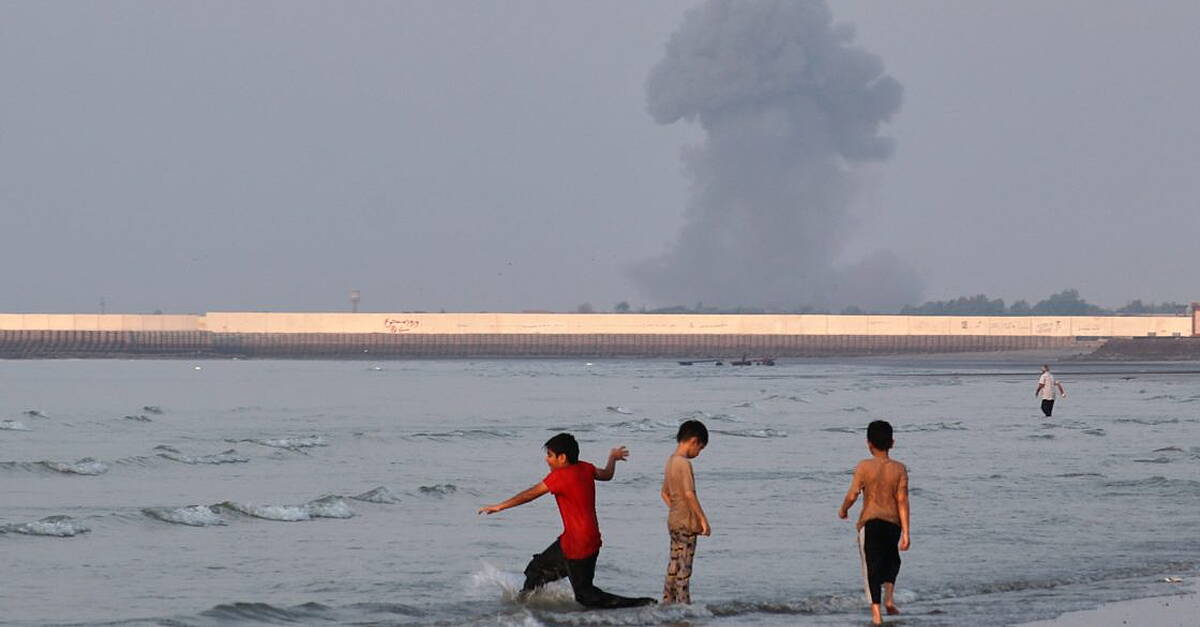
A series of explosions have been reported near a military base hosting US forces in northern Iraq, hours after the American military said it had wrapped up its 13th night of strikes against Iran.
At least seven blasts were reported at around 9.30am local time (7.30am BST) in the city of Irbil, the capital of Iraq’s semi-autonomous Kurdish region, and observed at least four plumes of black smoke rising into the sky from areas near or inside the base afterwards.
The US and Iran have exchanged escalating strikes in fighting that began with a struggle over control of the strategic Strait of Hormuz.
Iranian state media reported that four people had been killed and nine injured in the US bombardment.
US Central Command said the latest barrage was designed to “further degrade Iran’s ability to threaten civilian mariners and commercial vessels transiting regional waters” as the Americans push to regain control over the Strait of Hormuz, through which a fifth of the world’s oil and gas transited in peacetime. It said the strikes ended shortly before 5am local time (2am BST) on Friday.
Bahrain activated its sirens twice later that morning, warning residents to shelter from detected incoming fire. Gulf states have also come under frequent fire over the past week.
The previous day, Yemen’s Iran-backed Houthi rebels said they targeted two Saudi oil tankers in the Red Sea, potentially widening the Iran war as international oil topped 100 dollars a barrel.
https://x.com/CENTCOM/status/2080431218449911850?ref_src=twsrc%5Etfw
Iraqi prime minister Ali al-Zaidi, whose government has close ties to both the US and Iran, was in Tehran on Thursday to call for peace and dialogue. He promised not to allow Iraqi territory to be used for attacks on Iran, his office said. Mr Al-Zaidi met with Trump earlier this month in Washington.
US strikes hit a naval base for the Revolutionary Guard in the north of Iran, the Iranian semi-official news outlets Fars and ISNA reported on Friday morning. Blasts overnight were also reported on Iran’s Qeshm Island, home to stores of naval assets including drone boats that Iran can use to attack vessels on the Strait of Hormuz, as well as in Isfahan province, where there is a major Iranian air base as well as one of Iran’s nuclear sites.
More strikes reportedly hit Iran’s south-west Khuzestan province and southern Fars province.
Four people were killed and five wounded in a US missile attack on the outskirts of Ahvaz on the Karun River, Iranian state media said. An attack in Lorestan province in Western Iran injured two, state media said, while two more were injured by explosions in the port city of Bandar Abbas, a critical hub for moving military supplies as well as trade cargo.
Meanwhile, the Houthis threatened to shut down another key trade route with the world economy already reeling from Iran’s closure of the Strait of Hormuz.
https://x.com/RapidResponse47/status/2080415074347286730?ref_src=twsrc%5Etfw
The Bab el-Mandeb Strait at the southern tip of the Arabian Peninsula, is a vital shipping chokepoint connecting the Red Sea to the Gulf of Aden. Around 12% of the world’s trade, including a fourth of global container traffic, passes through there, moving between Europe and Asia via Egypt’s Suez Canal.
The Houthi attacks put at risk oil shipments from Saudi Arabia’s Yanbu port on the Red Sea and present a “double whammy” on top of the disruption in the Strait of Hormuz, said maritime data and analysis firm Lloyd’s List Intelligence. Saudi Arabia has diverted millions of barrels a day of oil exports to Yanbu via an overland pipeline as the war has bottled up the Persian Gulf.
US president Donald Trump threatened “major military punishment” against the Houthis if their attacks on ships continue.
As the rhetoric escalated, so did economic fallout. The price of Brent crude oil, the international standard, spiked more than 6% to about 100 dollars a barrel. That’s the highest level since May, before the two sides reached a preliminary peace agreement last month that has since collapsed.
Iran says it has the right to manage traffic and potentially charge fees in the Strait of Hormuz, which was open to all toll-free before the war. It has attacked ships using a route through the strait that is overseen by US forces and intended to be outside Tehran’s control.
https://x.com/SecWar/status/2080020952952242256?ref_src=twsrc%5Etfw
Mr Trump said on social media on Thursday that sanctioned Iranian funds in the possession of the US will cover the expense of fixing boats damaged in the war.
“Please let this statement serve to represent, until further notice, that from this point forth, any and all damages done to Ships, Cargo, or anything related thereto, will be paid for by Iranian Money that the United States has in its possession, and controls,” Mr Trump said.
It was unclear what legal mechanisms the US leader would use to access and spend the funds, but he said that doing so would be “the fair and equitable thing to do”.
Iran’s foreign minister Abbas Araghchi condemned the suggestion, writing on X that “once governments normalise confiscation, no-one’s assets are safe. Ensuing chaos will not be pretty or peaceful”.