World
Eisenkot: PM asked me as IDF chief to order troops into bunkers in area where his son was serving

Yashar leader Gadi Eisenkot revealed that while he was serving as IDF chief of staff, Prime Minister Benjamin Netanyahu called him urgently to his residence, where he asked him to have military personnel in a specific sector in the Golan Heights enter into underground bunkers.
Eisenkot, whose Yashar party has pulled ahead of Netanyahu’s Likud in several recent polls, said in a television interview aired Wednesday that only after looking into the issue did he understand that one of Netanyahu’s sons was serving in the Israel Defense Forces in that sector and that this was the reason for the request.
Eisenkot was chief of staff from 2015 to 2019, and Netanyahu’s son Avner served in a battlefield intelligence gathering unit in the IDF from 2014 to 2017.
“This seemed like a strange demand to me,” Eisenkot told Channel 12 news, adding that he told Netanyahu, “There is a constant risk to civilians, to soldiers, but it is not the right thing to do.”
The former chief of staff said when Netanyahu tried to insist on the request, he understood there was “some family issue that was stressing him,” and that “there’s something completely crazy happening around him.”
He said, however, that he refused the request, to the prime minister’s displeasure, as Netanyahu’s concerns were not grounded.
Eisenkot said the incident sheds light on current events in which Netanyahu’s wife, Sara, called the head of the Shin Bet, David Zini, to request lifetime security protection for herself and the prime minister. In a separate report Wednesday, Channel 12 said decided to extend the security detail for Sara Netanyahu and the couple’s two sons for at least five years, despite opposition from professional officials in the agency.
The reported decision came after Hebrew media reported Tuesday that Netanyahu and his wife were exerting heavy pressure on officials in the Shin Bet and the National Security Council to approve the request, arguing that the war with Iran and other security developments justified the extended protection.
Netanyahu, who is himself guaranteed protection for the next 20 years, was reportedly seeking the extension to go into effect immediately, regardless of the results of the upcoming elections.
However, officials in the National Security Council and the Shin Bet were reportedly hesitant about the move, with sources saying that while they recognize the seriousness of potential threats, they saw no reason to decide now on security arrangements for the next five years.
The Prime Minister’s Office denied the reports, while the National Security Council and the Shin Bet refused to comment.
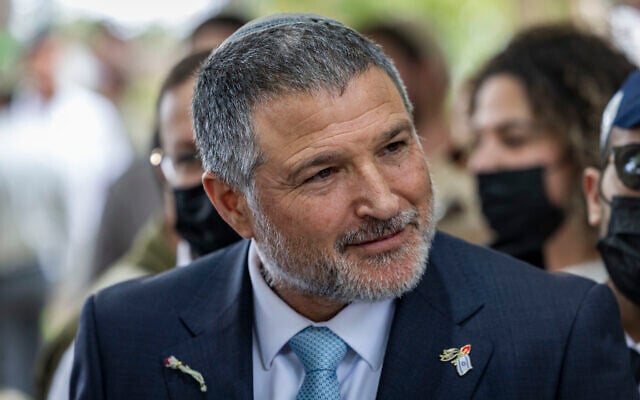
Eisenkot said in the Wednesday interview that he was “very troubled” by reports that Zini took the phone call from Sara Netanyahu, described the incident as “very grave,” and added, “The attempts to influence the head of the Shin Bet through family members, through people close to his family, commentators, or media mouthpieces — this is a completely insane situation.”
The former IDF chief also slammed recent comments by Zini that his loyalty lies with elected officials and not the state, and said such a person should be fired.
“If there’s a head of a security agency who feels that he owes personal loyalty, and acts accordingly, he should hand in his keys and leave… Anyone whose loyalty is not to the state, and whose actions were not in accordance with the law, will be required to hand in their keys and go home. And if they don’t, we’ll send them home.”