World
Children of Iran’s regime leaders are educating America’s students at colleges from New York to Los Angeles

Iranian leaders call the US the “Great Satan” and burn effigies of President Trump in the streets, but that doesn’t stop them from sending their kids here to learn — and to teach.
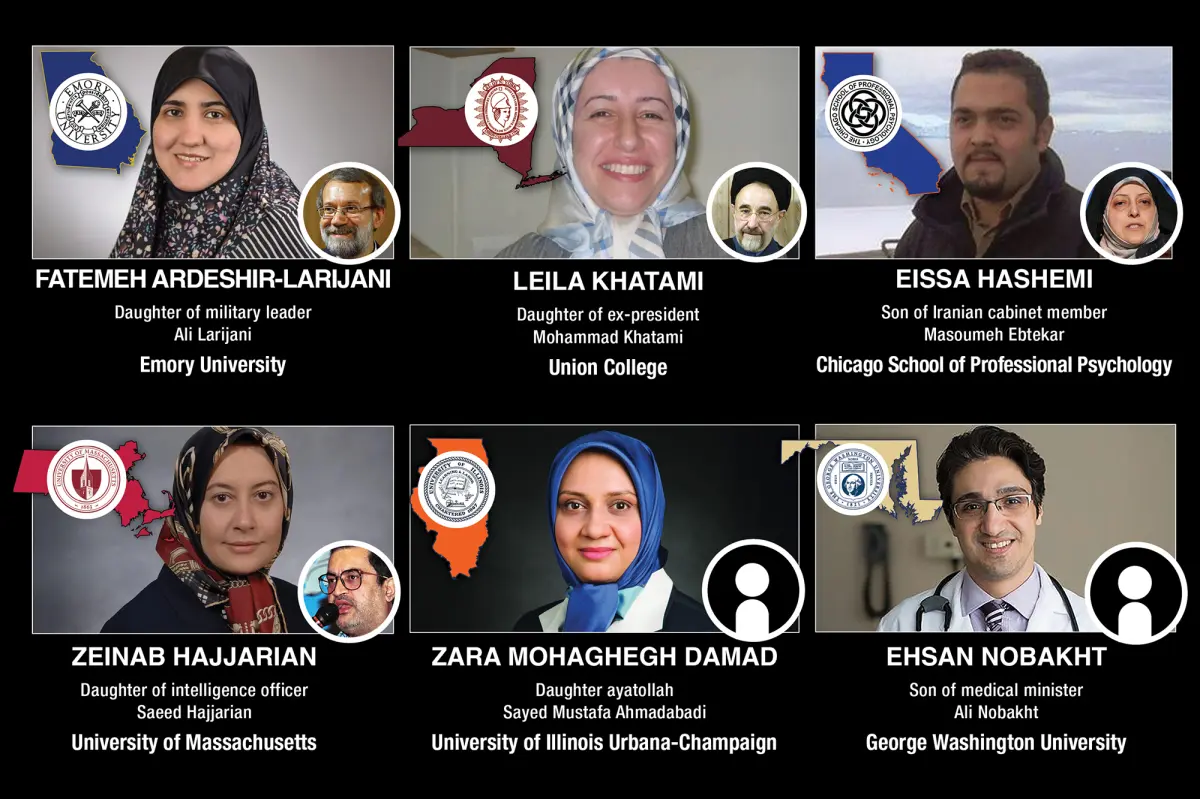
Children of regime leaders and bigwigs are at prestigious universities across the US, including the University of Massachusetts, New York’s Union College and George Washington University, The Post can reveal.
Sources said allowing people linked to the regime to assume such influential positions could present a threat to US values.
“I would think that there would be a security risk as Iranian academics have been critical in forming public opinion on the left in the US, essentially deceiving liberals into thinking that the regime is more progressive, when it’s still advancing the same hardline agenda,” said Janatan Sayeh, an Iran analyst at the Foundation for the Defense of Democracies, a Washington, DC-based think tank.
The Post has seen no specific evidence against anyone featured in this story.
The daughter of Iran’s de facto leader Ali Larijani, who was killed in an airstrike Tuesday, is a medical doctor who taught at Emory University in Atlanta.
Fatemeh Ardeshir-Larijani was a doctor at the university’s prestigious Winship Institute until the university parted ways with her in January, according to reports, following pressure from dissidents.
Ardeshir-Larijani is herself a cancer survivor, who initially came to the US for treatment, according to Iranian dissidents who monitor the regime.
“Fatemeh Larijani … the daughter of Ali Larijani came to the United States for cancer treatment, the very country her family’s system condemns, while millions of Iranians are denied access to basic health care and opportunity,” said Lawdan Bazargan, a human rights activist from the Alliance Against Islamic Regime of Iran Apologists.
Pressure had been building for Ardeshir-Larijani to be fired — and possibly removed from the US — in light of the US-Iran war, although it had been building since the regime’s bloody crackdown on protesters that began in late December.
A Change.org petition signed by more than 156,000 people urges the Trump administration to deport Ardeshir-Larijani.
In New York, Leila Khatami, the daughter of former Iranian President Mohammad Khatami, teaches mathematics at Union College in Schenectady.
Mohammad Khatami was president from 1997 and 2005, and while he is considered a reformist within the country’s political system, dissidents say he was still part of a government that condoned human rights abuses and repression of its own citizens.
Following US airstrikes against Iran, which began last month, Leila Khatami’s photo and bio were removed from the Mathematics Department’s faculty and staff web page. Khatami’s aunt is a granddaughter of Ayatollah Ruhollah Khomeini, who ruled Iran after the revolution in 1979 until his death in 1989.
“They’ve turned Iran into a hell for us Iranians, while their children live in the West, holding key positions in universities and spreading anti-Western values,” said a critic of the regime on X.
Another Change.org petition, signed by more than 84,000 verified people, urged the Department of Homeland Security to investigate Khatami’s immigration status, according to a report. The Post is not aware of any evidence that Khatami’s immigration status was procured fraudulently.
“This is not personal revenge. This is justice,” said the petition started by an anonymous “Iranian Patriot.”
Known in Iran as Aghzadehs (“noble born”), such people are largely resented by their countrymen for living in the West while their high-ranking relatives promote anti-Western policies at home.
In total, there are estimated to be between 4,000 and 5,000 relatives of prominent Iranian regime leaders and bureaucrats living in the US, according to experts and dissidents. Hundreds more have taken up residence in Canada and Australia.
“A lot of them are nephews and nieces and it’s hard to track them because they don’t have the same last name as the regime leaders,” Sayeh noted.
Zahra Mohaghegh Damad is the daughter of Ayatollah Mostafa Mohaghegh Damad, a prominent Shia cleric who has held various positions within the Iranian government.
Zahra is also a niece of Ali Larijani and works as a professor in the Department of Nuclear, Plasma and Radiological Engineering at the University of Illinois Urbana-Champaign. She is also director of a unit that analyzes risk of “complex technological systems” including commercial nuclear plants and reactors.
Eissa Hashemi is an associate professor at the Chicago School of Professional Psychology in Los Angeles. His mother, Masoumeh Ebtekar, is a former member of Parliament in Iran who worked as a spokesperson for the student militants who held 52 diplomats hostage at the US Embassy in Tehran for 444 days during the 1979 revolution.
At that time, Masoumeh Ebtekar was nicknamed “Screaming Mary” by the US media for her intense rhetoric when delivering the regime’s message in English. Up until 2021, Masoumeh also served as the highest-ranking woman in Iran’s government, overseeing women’s issues and the environment. She has consistently defended hijab laws for women in the country.
“There is no city in the world where you can walk naked in the streets and you won’t be approached by a particular regulatory body,” she said in 2018.
Zeinab Hajjarian is the daughter of Saeed Hajjarian, who played a prominent role in Iran’s security and intelligence apparatus after the 1979 revolution. He was an important adviser to Khomeini in the 1980s, even as he has been described as a reformist. Zeinab is assistant professor of biomedical engineering at the University of Massachusetts Lowell.
Meanwhile, at George Washington University, Ehsan Nobakht is an associate professor at the School of Medicine and Health Sciences, specializing in kidney disease and hypertension. He is the son of Ali Nobakht, a renowned physician in Iran and reformist former member of Parliament who served as a former deputy minister in the country’s Department of Health.
Despite holding so-called reformist political views, critics of the regime claim reformers and hardliners operate within the same power structure and share responsibility for maintaining the status quo of hardline religious views, critics say.
“In practice, power in Iran is concentrated within a relatively closed network of interconnected families and political figures,” Bazargan told The Post.
“For a large part of Iranian society, the idea of ‘reformist vs. hardliner’ has lost its meaning. It is seen as an internal division within the same system. Yet Western media and some analysts continue to frame Iranian politics this way, which, in effect, helps prolong the life of the regime by suggesting that meaningful change can come from within it.”