World
Board of Peace finalizing plans for Gaza, but implementation timeline up in the air

Representatives from the various US-led Board of Peace bodies involved in the postwar management of Gaza are meeting this week in Cyprus, as they seek to prepare a committee of Palestinian technocrats for entering the Strip in order to replace Hamas as governors of the war-ravaged enclave.
While an Arab diplomat from one of the mediating countries and a Palestinian official familiar with the matter characterized the Cyprus gathering as an opportunity to “recalibrate” the initiative after a rocky first six months, a Board of Peace official insisted last week that the meeting would be routine and that the process is largely moving along according to plan.
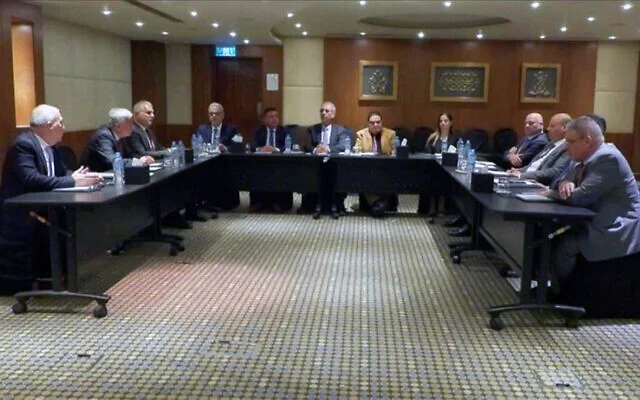
Indeed, the Board of Peace held a previously unreported additional workshop last week at the Egyptian coastal town of Ain Sokhna, which was attended by the entire panel of Palestinian technocrats, formally known as the National Committee for the Administration of Gaza (NCAG).
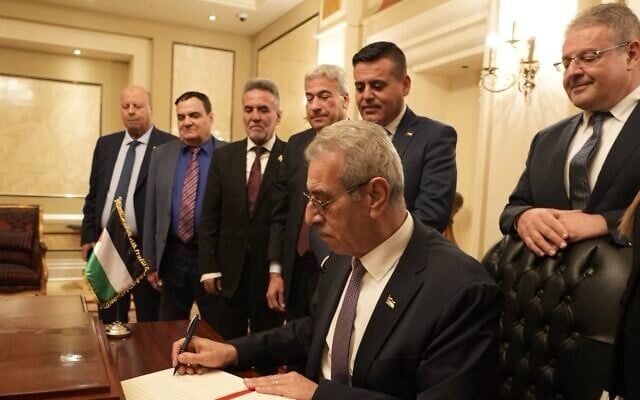
The NCAG was unveiled in January — along with several other Board of Peace bodies — and its dozen-plus members subsequently moved from Gaza and the West Bank to a hotel in Cairo, where they have been readying plans for replacing Hamas.
While no date was ever announced for when the NCAG would enter Gaza, one member of the panel acknowledged mounting frustration, saying that they did not expect the transition to be as lengthy as it has been.
The NCAG member spoke on condition of anonymity, as the US-controlled Board of Peace has barred members from speaking to the media. NCAG chief commissioner Ali Shaath did a small number of interviews shortly after his appointment, but since then has largely avoided the public eye.
The Board of Peace’s Gaza envoy Nickolay Mladenov has insisted that the main obstacle preventing the NCAG from entering Gaza is Hamas’s refusal to give up its weapons.
A diplomat from each of the Mideastern mediating countries — Egypt, Qatar, and Turkey — acknowledged that Hamas has sought to drag out negotiations on the issue. However, they also argued that Israel’s refusal to adhere to the terms of the first phase of the October 2025 Gaza ceasefire has posed a major obstacle as well. They added that Prime Minister Benjamin Netanyahu’s government has been increasingly uncooperative as the fall Knesset elections approach and that there is little hope for a breakthrough until after that vote is held.
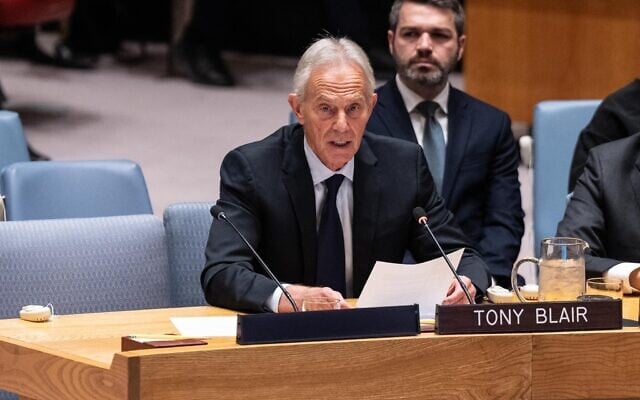
In the meantime, NCAG members hold frequent meetings with foreign diplomats in Cairo and have undergone several training sessions run by senior Board of Peace official Tony Blair’s Institute for Global Change government consulting firm (TBI).
Blair himself, along with roughly eight TBI staffers, is slated to participate in the Cyprus “strategic workshop” running from Tuesday to Thursday.
The Times of Israel revealed earlier this month that Blair has taken on a larger role in the Board of Peace, given the quantity of resources that his institute is able to provide.
What Egypt meeting says about Board of Peace direction
TBI was also involved in the planning of last week’s two-day “preparatory workshop” in Ain Sokhna. The Times of Israel obtained the agenda for that meeting, which offers a window into what the Board of Peace has planned for the rebuilding of Gaza.
The stated goal for the meeting was to “focus on detailed technical and operational discussions across the various NCAG commissions. The objective is to review progress, resolve outstanding issues, align priorities, and prepare recommendations and decision papers for leadership consideration.”
The NCAG is made up of at least 12 commissioners who are each responsible for a different office, including agriculture, communications, education, finance, health, housing, internal security, justice, social security, trade, tribal affairs and utilities.
Several individuals have been added to the NCAG staff but have not been announced, including at least three deputies who will be working under internal security commissioner Sami Nasman. They will all be attending the Cyprus workshop, which will have more of a focus on security issues.
The Board of Peace has been working to advance the establishment of a Palestinian police force as well as an International Stabilization Force (ISF), which will be responsible for maintaining law and order in addition to securing the Strip’s borders.
Egypt has agreed to host the training of police recruits, and four countries have agreed to contribute troops to the ISF, but Israeli approvals are needed for both forces to deploy, and those have not been secured, two Arab diplomats told The Times of Israel. Those approvals include signing on to a Status of Forces Agreement (SOFA) with each ISF contributing country in order to establish the legal guardrails of foreign military personnel stationed abroad. A Board of Peace official insisted the matter would be resolved shortly, but did not provide a timeline.
The Egypt workshop itinerary began with icebreakers, apparently scheduled due to the hiring of additional professional staff at the Board of Peace umbrella body, Mladenov’s Office of the High Representative and TBI, all of whom had not previously been together in the same location.
The Board of Peace staff now also includes several US officials who were originally brought into the Trump administration in order to serve in Elon Musk’s Department of Government Efficiency (DOGE).
Among the sessions in Ain Sokhna was one focused on the “digital wallet,” which the Board of Peace is apparently planning to make significant use of in order to move Gaza’s economy online, rather than having to rely on cash. A representative from the World Bank was also slated to participate in this week’s Cyprus meeting.
Another session focused on donor engagement, as the Board of Peace is certain to try to solicit international support for the reconstruction of Gaza. While $17 billion was pledged at a donor conference in February, only a tiny fraction has been transferred, because the Gulf countries that offered the largest sums were the most targeted by Iran in the weeks that followed, which will likely force a budget reprioritization.
The Egypt workshop last week also focused on revamping Gaza’s supply chain, which the Board of Peace is working to turn into a closed-loop import system with a pre-approved catalogue of suppliers and products that will be distributed at hubs mirroring those run by the Gaza Humanitarian Foundation, an Arab diplomat said.
GHF was established in the spring of 2025 in order to box Hamas out of the aid process, but it was rolled out in the midst of a hunger crisis caused by Israel blocking all aid from entering the Strip for over two months. Desperate Gazans seeking aid were forced to walk long distances, while dodging repeated IDF fire, to reach a small number of GHF sites, which were shut down as the war ended. The initiative was the brainchild of several Israeli businesspeople who now also have prominent roles in the Board of Peace and who are still determined to prevent Hamas from profiting from Gaza imports.
The #ISF welcomes its newest members from the Royal Moroccan Armed Forces. Their arrival strengthens the international effort to support the people of Gaza. #StabilityStartsHere pic.twitter.com/xsp6GTgaC1
— Board of Peace (@BoardOfPeace) June 23, 2026
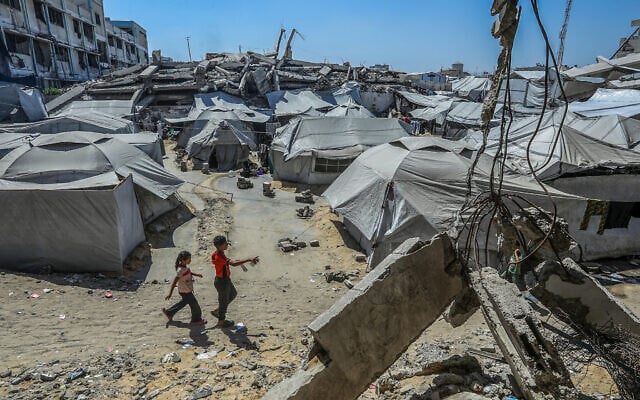
A different Ain Sokhna session was titled “Humanitarian Camps, Temporary Communities & Early Recovery Needs” — an indication of the housing ideas that the Board of Peace is hoping to advance. A Board of Peace official said last week that the first temporary community would be built on the ruins of Rafah, in the IDF-occupied part of the Strip that has been dubbed the “green zone.”
While the ceasefire required Israel to pull back to a yellow line that roughly divided the Strip into eastern and western halves, Netanyahu announced last month that he had directed the army to take over an additional 20 percent of the Strip, squeezing roughly two million Palestinians into an even smaller section of the enclave closer to the coast.
Amid the deadlock in Hamas disarmament talks, the Board of Peace is hoping to at least begin building temporary communities in the green zone, but it is unclear whether Palestinians will be willing to move to the Israeli side of the Strip and whether the NCAG will lose legitimacy by operating under Israeli occupation. Moreover, additional Israeli approvals are needed in order to advance what is widely understood as the Board of Peace’s “plan B.”
The preference is for Hamas to agree to the Board of Peace’s disarmament plan, which would allow for reconstruction to begin across the entire Strip — including in the Hamas-controlled “red zone” — as Israel gradually withdraws.
Can a ‘yes, but’ from Hamas be enough?
Accordingly, talks between the Board of Peace, the Mideast mediating countries and Hamas officials have continued on and off in Cairo over the past several weeks.
The terror group has moved from rejecting outright the idea of disarming to offering proposals that begin with the handover of the weapons of its police force along with the relatively small number of heavy weapons that its military wing still has in its possession after years of Israeli bombardment, the two Arab diplomats said.
The tens of thousands of AK-47s that the military wing still has in its possession are a thornier issue, with Hamas officials fearing that they will lose any leverage they have left by giving those up, especially up front, one of the Arab diplomats said.
Hamas negotiators have also been pushing for more clear-cut language tying the disarmament process to Israel implementing phase one commitments, the deployment of the NCAG and ISF in Gaza and the establishment of a Palestinian state, but Israel has rejected such amendments.
The Arab diplomat speculated that mediators could eventually coax Hamas to offer a “yes, but” response to the Board of Peace’s disarmament proposal, but that the question would then be whether the US would deem that as sufficient to then pressure Israel to get on board. Given that political capital in Washington has already been spent to hold Israel back from continued attacks in Iran and Lebanon, it is unclear whether there is a desire to use what is left to try to restrain Israel on Gaza as well.
In the meantime, the Board of Peace is moving ahead with its plans.
The agenda obtained by The Times of Israel stated that the goal for the Cyprus summit is to “focus on a smaller set of cross-cutting strategic issues that require leadership direction and alignment.”
“Discussions will concentrate on security arrangements, the evolving spatial planning, funding and financing requirements, communications strategy, and the legal and governance framework required to support implementation,” it added.
The NCAG member insisted to The Times of Israel that serious plans are being crafted for the committee to govern Gaza efficiently, but they acknowledged that those schemes will be harder to implement as more time passes.