World
Australian surfer miraculously survives attack from ‘world’s most venomous animal’

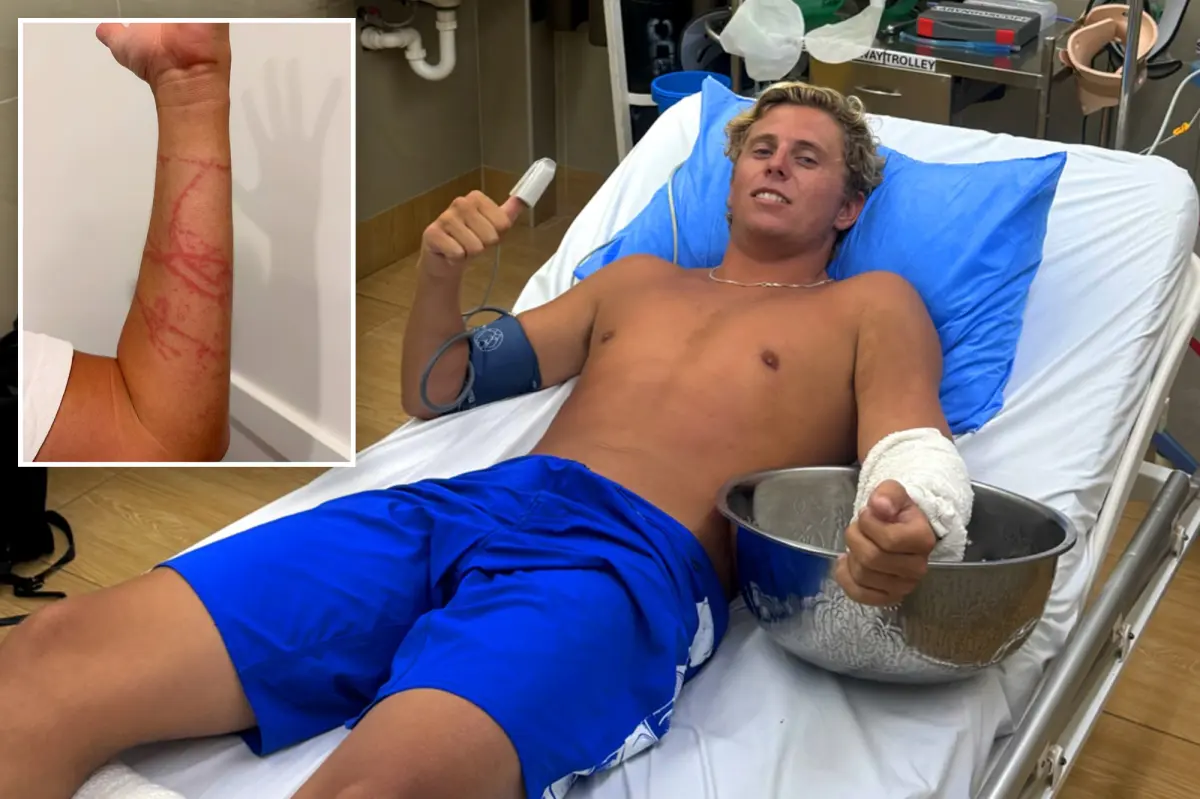
An Australian surfer is lucky to be alive after being stung by the “world’s most venomous animal” while on holiday in Fiji.
Sydneysider Guy Rowles was on the very first day of his surf trip with his dad when he jumped into the water at Cloudbreak, a popular spot in Tavarua, known for having some of the best waves in the world.
The 30-year-old roofer had been in the water for around half an hour when he suddenly felt a painful zap on his arm.
Looking down, he saw tentacles wrapped around him, his entire body suddenly jolting in pain as he tried his best to rip them off his skin.
He had just been stung by the world’s most venomous creature – the box jellyfish.
“I was in the water for 30 minutes when I felt something sting my arm really bad, it felt like boiling hot oil,” Guy told News.com.au.
“It kept getting worse. I paddled over to my guide, Sujee, who owns the surf stay. He said straight away, ‘That’s a box jellyfish, you need to get to the boat asap.’
“We rushed to the boat and he said we need to get to a hospital right now. It was getting harder to breathe.
“It felt like I was breathing through a straw. I was convulsing, couldn’t stop sweating, I was shaking and my heart was beating out of my chest.
“My fingers and toes were tingling. The burning pain on my arm wouldn’t stop, it was horrible.”
As they were surfing in a remote area, it would be at least 40 minutes before Guy and his father could get to the mainland, and then another 20 minutes to get to a hospital in Nadi.
On the way there, he had just one thought: Would he survive?
“I was googling box jellyfish on my phone and I saw that the venom takes just two to five minutes to get into your system,” he said.
“I saw how fast it could kill you. I just kept asking my dad, ‘Am I going to die?’
“And he kept saying, ‘No mate, you’ll be fine, just concentrate on breathing and stay calm.’
“Once we got to the hospital, I saw the doctor go pale once they realized what it was.
“I could have been dead within minutes if it had been worse.”
In desperation, Guy’s father pleaded with doctors to give his son some antivenom to help with the sting.
But sadly, it was too late.
“The doctor said too much time had passed and that the antivenom wouldn’t help,” he explained.
“I just had to wait it out. He put vinegar on my sting and they just kept monitoring my heart and my breathing.
“My dad was such a huge help, he was keeping calm and kept saying, ‘You’ll be right, mate, just keep breathing.’
“He definitely helped me through it.”
“I was hooked on all these things and was being given so much morphine for the pain. They watched over my for the next four hours.”
Miraculously, Guy survived being stung by the world’s deadliest marine animal.
By the next afternoon, he was back in the water.
“I felt a bit weird for the rest of the day, but the next day I was feeling better,” he said.
“I was back surfing by the next afternoon. I was definitely a little anxious to get back in the ocean.
“I was looking around more than normal and hypersensitive to anything touching me. But I knew I had to get back in.
“The ocean is my safe space and my happy place. There will be nothing that could ever keep me away from that.”
While he knew of the dangers of the box jellyfish, he never imagined that he would ever actually be stung by one.
“I learnt about box jellyfish in school and I knew they were super deadly and venomous,” he said.
“But I honestly never thought I’d have to worry about that in Fiji.
“Apparently the government had put out a warning before I got here, but I didn’t know.
“I never thought this would happen to me.
“The Fijian people are the best in the world. They are so nice and helpful, and looked after me so well.
“I will always keep coming back here.”
Talking to surfing magazine Stab, he said he told his mom he loved her before being rushed to the hospital.
“They said I was lucky that I didn’t get it on my face or neck,” he told the outlet.
“And that if I wasn’t young and healthy, it could’ve gone a lot differently.”
He has since made a full recovery, but said the experience “definitely puts things into perspective.”
Guy urged other surfers and swimmers to bring vinegar with them in the case of emergencies like this one.
Dousing the area with vinegar helps to neutralize remaining stinging cells and removes any remaining tentacles from the skin.
Box jellyfish stings like the one Guy suffered, which covered more than half of one limb, are considered extremely life-threatening.
According to Australian Geographic, no other venomous animal in Australia has a more deadly record than the box jellyfish.
The creature is named after its unique body shape and has tentacles that can grow up to three meters long.
They are covered in nematocysts, which are tiny harpoons attached to a venom-filled bulb.
As a result, it can sting and kill a person in minutes.
“If a person comes into contact with enough stinging cells of a box jellyfish, they will die within just a few minutes unless an antivenom can be administered,” Australian Geographic states.
“Survivors of box jellyfish stings usually bear lifelong physical scars from the encounter, at the sites where the stinging cells came into contact with them.”
Box jellyfish are most commonly found in warm coastal waters around the world, but the dangerous varieties primarily reside in the Indo-Pacific region and northern Australia.
Just one week before Guy’s trip, the Fiji government had released a health notice about the possibility of jellyfish being in the water.
“The Ministry of Health and Medical Services, with the Ministry of Fisheries, are urging Fijians to take precautionary measures when out at sea with the presence of Box Jellyfish – a poisonous and venomous jellyfish,” the notice read.
“The Ministry of Health & Medical Services is concerned after a number of patients have been presented to the Ministry’s Hyperbaric Unit with breathing problems after being out at sea.
“Members of the public are urged to take proper heed of this advisory and to visit their nearest healthcare facility should they have any signs and symptoms.”
Symptoms of stings include severe burning pain, tentacle marks, difficulty breathing and collapsing.
There are some precautionary measures that swimmers and surfers can take to avoid being stung, including wearing protective clothing, such as a full-body stinger suit.
The Fiji government said it is key to look out for local warnings and avoid swimming or diving at dawn or dusk when the jellyfish are present in significant numbers.
In the event of an injury, a victim should be removed from the water and taken to a hospital immediately.