World
Another rumble in the trade jungle: Will Trump’s new tariffs survive a court challenge?

PHILADELPHIA – More turbulence looms in global trade, with a new wave of tariffs replacing the 10 per cent surcharge that the United States currently applies to all imports across all nations, which expires in a matter of weeks.
The incoming tariffs, proposed under Section 301 of the US Trade Act of 1974, target 60 economies that are the source of nearly all of US imports.
Most trade experts view these as part of an effort to recreate a tariff wall after President Donald Trump’s “Liberation Day” tariffs – enacted in April 2025 under the International Emergency Economic Powers Act (IEEPA) – were struck down by the Supreme Court in February 2026.
In response, the administration immediately imposed the global 10 per cent temporary tariff under Section 122, claiming the US economy was threatened by a balance of payments crisis. This is set to expire on July 24.
Will the transition be smooth and will the new tariffs attract lawsuits and survive them?
Half a dozen trade experts interviewed by The Straits Times said the administration may not be fully ready to impose the new tariffs by July 24.
But once imposed, court challenges are almost inevitable as US companies and foreign governments contest the new penalties. In some specific cases, experts said, they may be sustained.
Section 301 allows the US government to investigate foreign practices deemed unjustifiable, unreasonable or discriminatory towards American businesses and to impose remedies such as tariffs or import restrictions.
US Trade Representative (USTR) Jamieson Greer announced on June 2 that the US intends to impose tariffs ranging from 10 per cent to 12.5 per cent on countries for not cracking down on the use of forced labour – referring to work done under coercion – in their supply chains.
US Trade Representative Jamieson Greer announced on June 2 that the US intends to impose tariffs ranging from 10 per cent to 12.5 per cent on countries for not cracking down on the use of forced labour in their supply chains.
PHOTO: REUTERS
Similarly, the Trump administration is pursuing a second basis for its use of Section 301: targeting structural “excess capacity” in global manufacturing. Foreign governments, it says, support their industries to overproduce, flooding international markets and skewing markets against American firms.
The tariffs premised on allegations of forced labour could feasibly be in place when the Section 122 tariffs expire, said Madeline Chalecki, a senior trade policy analyst at the Atlantic Council’s GeoEconomics Center.
USTR released its proposed remedies on June 2, initiating a mandated window for public comments until July 6 and a hearing date for July 7.
Following the hearing, USTR will likely publish its Final Action Notice a couple of weeks later and could implement new tariffs soon after, dovetailing neatly into the Section 122 deadline.
The excess capacity investigations would move on the same timeline but USTR has yet to release its proposed remedies, Chalecki said.
“With just over 30 days remaining until the Section 122 tariffs expire, it’s unlikely these will be in place in time,” she said.
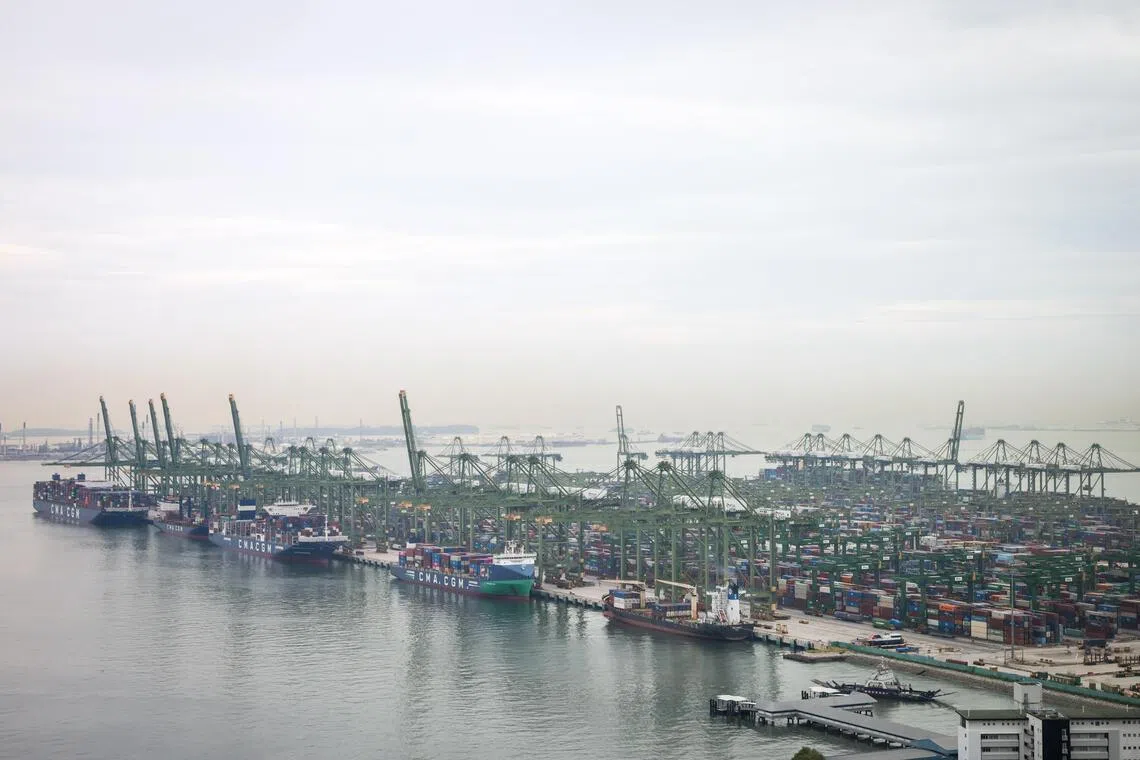
About a third of Singapore’s domestic exports to the US could be subject to a 12.5 per cent duty under forced labour tariffs, an allegation that the Republic disputes.
Forced labour occurs when individuals are compelled through force, fraud or coercion to work against their will. About 28 million people around the globe were in forced labour in 2022, according to the latest International Labour Organisation statistics.
The US says that the lack of transparency in global supply chains enables goods produced with forced labour to be exported to the US.
The use of forced labour is also prevalent within the US, including in industries such as food services, construction and agriculture, investigations by US agencies show.
Singapore’s Ministry of Trade and Industry says there is no evidence of Singapore’s role in supply chains of goods associated with forced labour and the Republic is not aware of any goods produced with forced labour exported to the US from Singapore.
Experts say they find the inclusion of Singapore puzzling.
No evidence of involvement has been presented by USTR, notes William Reinsch, a trade expert at the Center for Strategic and International Studies (CSIS).
“It looks like the administration just went after everybody they had negotiated a trade agreement with or who the US has a trading relationship with,” he said.
In its 98-page report on forced labour tariffs, USTR simply asserts in two or three paragraphs that the country in question “failed to impose and effectively enforce a forced labour import prohibition”.
“There are few signs any real investigations were conducted, and in any event, the three months it took to produce the report would not have been enough time to do a thorough job anyway,” he said.
Chalecki said the USTR is not making the argument that Singapore relies on forced labour in supply chains.
“Rather, it’s asserting that the country lacks a formal system to prohibit the importation of goods produced with forced labour and, therefore, contributes to an unfair global trading system,” she said.
“This is a convoluted argument and an unprecedented use of Section 301,” she added.
“Unlike other Section 301 investigations, which draw a clear conclusion that a country’s practices directly harm US firms, this is arguing that one country is not doing enough to stop a global problem, therefore, indirectly harming US firms.”
The USTR needed to find an issue that could enable a blanket tariff, like IEEPA or Section 122, said Chalecki.
“It would be extremely difficult to prove that all countries are actively engaging in one practice that directly harms US industry. It’s much easier to prove that all countries are complacent in a global system of trade that doesn’t do enough to prohibit forced labour, indirectly harming US industry.
“The investigation and proposed remedies are less about Singapore or any individual country’s active involvement in trade in forced labour, and more about addressing a global problem with a global tariff,” she said.
Singapore economist Manu Bhaskaran, partner at the Centennial Group International, agreed.
“The grounds are mystifying since we do not do forced labour and have tight standards. But the grounds don’t matter, this is not about facts, it’s about what the administration thinks it can impose on others,” he said.
“The administration needs tariffs to fill in the ever-growing fiscal hole created by its reckless fiscal policy. And, tariffs are a core element in this president’s policy agenda,” Bhaskaran said.
It is a view shared by Marc Mealy, executive vice-president and chief policy officer at the US-Asean Business Council, which advocates for better trade and investment relations with Asean nations.
“The administration has been pretty clear, or even transparent to some degree, that it intends to use the Section 301 provisions as a basis for basically recreating the IEEPA tariffs that the court ruled unlawful,” Mealy said.
The allegations about excess capacity are also a poor fit for Singapore.
“A more intellectually honest analysis would show that Singapore, as a small country, has a lot of industrial capacity because of how competitive its economy is in attracting investment, not because it is somehow using subsidies or unfair trade rules or regulations,” said one trade veteran who asked not to be named.
“And if you’re alleging that, then you’d also have to be alleging that American companies, which are some of the biggest investors in Singapore, are somehow involved in unfair trade practices.”
The trade veteran pointed out that trade law experts have questioned if the investigation was “intellectually honest”. He said it was a moot point.
“The law says you must do an investigation, and the USTR has done an investigation. I’m not sure you can then say they broke the law,” he said.
Some experts say American courts could strike down the new tariffs the way they struck down the IEEPA tariffs.
Alan Wolff, the former deputy chief of the World Trade Organization, has argued that mass, across-the-board use of Section 301 to impose broad tariffs is legally vulnerable and courts could strike it down because it deviates from Section 301’s statutory purpose
“The courts are likely to analyse this issue much as they did in determining that neither the emergency authority under IEEPA nor the balance of payments authority under Section 122 empowered the President to impose sweeping tariffs on nearly all imports from virtually every country,” he wrote in a commentary for the Petersen Institute of International Economics.
Other analysts are less certain.
What is clear is that there will most likely be lawsuits filed against the process and outcomes of the two Section 301 investigations, said Wendy Cutler, a former US trade negotiator.
“What’s less clear, however, is how the courts may rule,” said Cutler, now senior vice-president at the Asia Society Policy Institute based in Washington.
And in light of the fact that the Supreme Court on June 15 declined to review a case challenging President Trump’s first term Section 301 tariffs against China, the odds of the courts ruling against the current 301 tariffs go down considerably, she noted.
Chalecki said that while she agreed that the courts have been hesitant to give the administration broad power to set tariffs, a power that the US Constitution gives to Congress, Wolff’s argument would not necessarily apply to Section 301 tariffs.
“In this case, it is much greyer whether the administration is exceeding the use of Section 301 because the statute specifically allows for the imposition of tariffs to address practices that are ‘unjustifiable’, ‘unreasonable’, or ‘discriminatory’ towards American businesses and USTR has gone through the formal processes to prove their case,” she said.
But, specifically, the forced labour tariffs are more vulnerable to legal challenges, Chalecki pointed out.
“Section 301 has not been used to address a global problem, and the scope of the investigation is so broad it could reasonably be assessed as exceeding the authority,” she said.
“The excess capacity investigation, on the other hand, is more targeted and more traditional, so I think it could hold up in court,” Chalecki said.
In any case, do not expect any quick court decision.
“Nothing moves really fast in our judicial system, although the lower courts have been fairly efficient with the tariff cases,” said CSIS’ Reinsch.
“You can’t really file a lawsuit until the tariffs are imposed because you want to find plaintiffs who have been actually harmed by them, so the process is not likely to start before July 24 when the Section 122 tariffs expire, and the 301 tariffs would presumably go into effect.
“Assuming lawsuits are filed shortly after that, I could see the initial court decision in early autumn, with the inevitable appeal decided by the end of the year and a Supreme Court decision next year.”