Society
Africa cannot eat declarations, Jonathan tells leaders as food crisis deepens

By Kazeem Ugbodaga
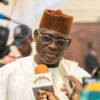
Former Nigerian President Goodluck Jonathan has challenged African leaders to move beyond agricultural declarations and political commitments, insisting that the continent’s food security and economic future depend on turning policies into investments and measurable results.
Jonathan made the call on Wednesday in Kigali, Rwanda, at an Investors Forum organised by the African Agricultural Technology Foundation (AATF) on the sidelines of the African Food Systems Forum, where more than 5,000 participants from over 50 countries are examining ways to increase investment in Africa’s agri-food systems.
The former president, who serves as AATF’s Goodwill Ambassador for Agricultural Technology, argued that Africa has spent years developing ambitious agricultural frameworks but now faces the more difficult task of ensuring that those commitments translate into higher productivity and better livelihoods for farmers.
“Africa’s food systems stand at a critical crossroads,” Jonathan said, pointing to intensifying climate shocks, rapid population growth, limited opportunities for young people and persistent weaknesses in storage, processing and access to markets.
He said three factors must come together if Africa is to move from declarations to tangible outcomes: proven agricultural technologies, patient capital and large-scale commercialisation.
“Turning this agenda from declaration into tangible impact requires three elements working in concert: proven technologies that raise productivity and strengthen resilience; patient capital that enables long-term investment and growth; and commercialization at scale that connects innovation to markets and farmers to opportunity,” he said.
Jonathan argued that agriculture should no longer be treated as a peripheral sector because its performance is directly linked to Africa’s ability to create jobs, feed its growing population, industrialise and withstand climate-related shocks.
“Put simply, if Africa is to achieve the growth, prosperity, and development to which it aspires, agriculture must be at the center of our efforts,” he said.
He acknowledged that African governments had already demonstrated political commitment through initiatives such as the African Union’s Comprehensive Africa Agriculture Development Programme and the Malabo Declaration.
But he said the real test would be whether those commitments could be converted into funding, policies and programmes that reach farmers.
Jonathan also placed young Africans at the centre of the transformation, urging governments to provide incentives capable of attracting a new generation into agriculture and encouraging youth-led innovation across the food value chain.
He called for stronger collaboration among governments, research institutions, private companies, farmer organisations, development agencies, donors and investors.
Technology, he said, must also move beyond laboratories and pilot schemes to farmers’ fields, where its impact can be measured through increased yields, incomes and resilience.
Jonathan urged investors at the Kigali forum to view themselves as long-term partners in Africa’s agricultural transformation, rather than merely financiers.
He said AATF’s next phase should focus simultaneously on scaling technologies already proven to work and developing new solutions for farmers, with the organisation seeking resources and partnerships covering the next five to ten years.
His message ultimately centred on a widening gap between Africa’s agricultural ambitions and their implementation: the continent has produced the declarations, he said, but now needs the capital, technology and political discipline to deliver results.