Trends
A Dress Mishap at 16 Inspired Oluwasewa Akinrimisi to Build a Global Fashion Brand

Oluwasewa Akinrimisi’s graduation ceremony in 2012 was supposed to be her announcement to the world. The day she finally shed her secondary school uniform for a beautiful dress.
She was so consumed by the excitement that she had sketched her dress’s design herself, completely unaware of the nightmare that awaited her.
Instead of a celebration, she remembers a heavy, suffocating exhaustion as she and her mother walked into store after store across Lagos, searching for a graduation dress that did not exist for a plus-size body.
“Every store we stepped into, we could not find something in my size,” Oluwasewa recalls, her voice carrying the memory of that disappointed 16-year-old girl. “My mum runs a business; she’s a very busy person. Eventually, she said, ‘If we don’t get it here, we have no choice.’ We had to go to Yaba to pick a bend-down-select dress.”
The dress they found was unflattering. Her mother tried to soften the blow with an old-school Nigerian parent hack: “Just put an abortion belt on it, wear very nice shoes, and you’ll feel better.”
Oluwasewa didn’t feel better. The sadness enveloped her beyond her graduation day, and she spent the next two weeks crying, spiralling so hard she failed her university entrance exam. But inside that heartbreak, she realised something.
“There was a mixture of the fact that this was a life-changing moment, and I also didn’t look good,” she says. “I just knew I never wanted to feel like that again.”
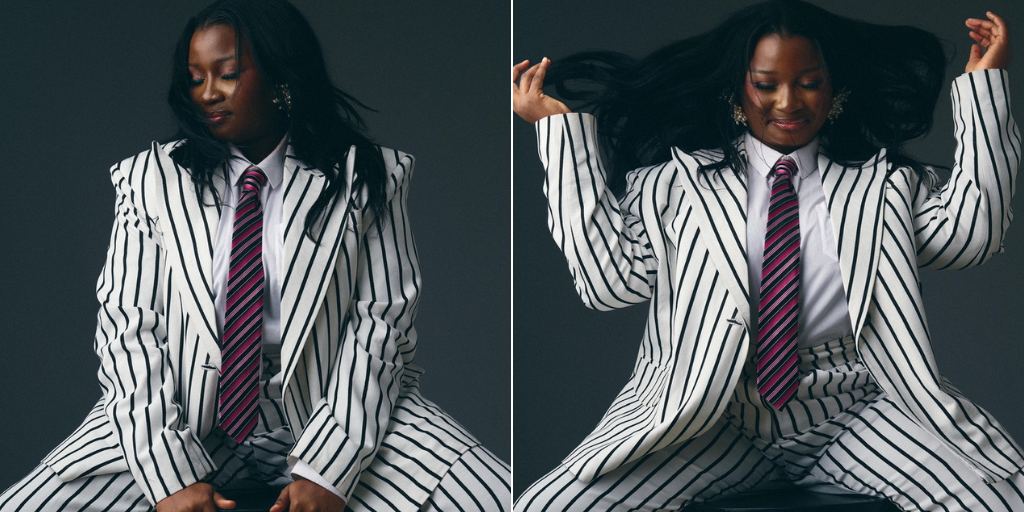
13 years later, Oluwasewa isn’t crying in fitting rooms anymore. At 29, she is the Founder and Creative Director of Sewasimilara (derived from her name, Oluwasewasimilara), a bootstrapped, six-figure fashion brand operating out of a duplex in Lagos and serving clients worldwide.
This is the story of how a 16-year-old girl who failed an exam after a dress mishap left her heartbroken built a global empire by standing her ground, mastering systems, and refusing to dilute her identity.
Shortly after the dress incident, Oluwasewa told her mother she wanted to learn tailoring. Her family immediately supported the idea. Her mother scouted a local tailor down the street and got Oluwasewa an apprenticeship. But back in 2012, no one thought fashion design was a viable career path for a young girl heading to university.
“Nobody saw it as a career,” Oluwasewa says. “They just thought, ‘Okay, maybe as you’re learning in school, you just have this extra handwork on the side.’”
But Oluwasewa wasn’t the typical apprentice. While traditional tailoring apprenticeships in Nigeria famously run for two to three gruelling years, Oluwasewa was out in three months.
“I had an eye for fashion and asked my boss a lot of questions. She could pick up the scissors, and I’d be like, ‘Why did you pick the scissors like that?’ At a point, she was frustrated by my many questions. But I was just so interested.”
By Christmas 2012, armed with three months of formal training, she transitioned to intense self-learning. When she entered the Federal University of Technology, Akure (FUTA) to study Statistics in 2014, her heart was already inside a sewing machine.
University brought unexpected challenges. Her mother’s business took a financial hit, forcing Oluwasewa to fend for herself. She went into survival mode. She tied gele, did makeup, styled hair, and sewed clothes. “Seven days a week, if you find somebody making money, I was there,” she laughs. “My major goal was just to eat. Not to have the best of anything; just to be able to eat.”
Her first real clients were secondary school girls preparing for a pageant. Remembering her own graduation trauma, she poured everything into making them feel beautiful. Subsequently, she began scouting girls at her university, transforming ordinary students into campus modelling stars through hair, makeup, and styling.
By her final year, while her classmates were preparing for corporate life, Oluwasewa looked at her full name, Oluwasewasimilara, which loosely translates to “The Lord has brought beauty into my life,” and realised her path was already written. Fashion wasn’t a side hustle; it was a calling. The Sewasimilara brand was born.
The Naira Life Conference is returning on August 22, 2026, in Lagos! Come learn from finance experts and industry leaders, and partake in unfiltered conversations about building wealth and diversifying your income stream in a country like Nigeria. Real stories, expert advice you can actually use, and a community ready to build wealth together. Secure your spot here.
Finishing university meant returning home to Lagos, which brought a harsh geographical and socio-economic reality into her full view: She was living and operating out of Ikorodu.
In the Lagos fashion ecosystem, geography is destiny. To the elite clientele in the upscale areas like Lekki and Ikoyi, Ikorodu might as well be another country.
“I didn’t know there was such a big issue with Ikorodu versus the rest of Lagos,” Oluwasewa says. “People would see my clothes on social media and call me. They’d say, ‘Oh, but you’re in Ikorodu? That’s so far away.’ They always used that as a reason to beat the price down. The price was already low, but they wanted it lower because of the perception of where I was based.”
Undeterred, she woke up early, packed her custom-made dresses into bags, braved the chaotic Lagos BRT buses — almost losing her leg in a bus terminal stampede once — and took ferry rides to deliver pieces to Island influencers.
By 2019 and early 2020, her work was already yielding returns. She was building online momentum, making sample pieces from her mother’s bedroom.
Then, in the middle of the pandemic, she got her first big break: a massive government gig to produce 2,000 fabric face masks, which she executed with a designer friend. The contract brought her first major financial win of about ₦500,000. Her mother celebrated by making a victory meal of pounded yam.
But the high from this win was quickly followed by devastating lows. Shortly after the mask contract, tragedy struck twice in a single week.
“My niece accidentally threw fire into my workspace and burnt down half of the room,” she says quietly. “All my savings, my fabrics, gone. In the same week, my Instagram page got hacked.”
With her physical workspace in ashes and her digital storefront stolen, many would have thrown in the towel and looked for a 9-to-5 job. Her parents definitely dropped hints, asking when she was going to get a “serious” job. Oluwasewa stayed down for exactly two weeks.
“I didn’t have a second option. It was either this or nothing,” she says. She braced herself and decided to keep moving.
Late 2020 brought another test. Oluwasewa entered a high-profile runway design competition organised by WAW Soap. Beyond showcasing her designs, she wanted to make a statement. So, she demanded a plus-size model on her runway, forcing the organisers to hold special auditions.
Her collection featured transformative pieces that changed silhouette as the models walked. “It got the loudest reaction from the audience. Everybody was screaming,” she remembers. Yet, when the winners were announced, Sewasimilara didn’t make the cut.
“I left there feeling like, ‘You know what? I’m going to prove them wrong.’ It was the first time I ever got to say publicly that I am an inclusive fashion designer, and I stood my ground.”
The universe rewards those who stand their ground. In 2022, an international shoe designer based in Canada slid into Oluwasewa’s Instagram DMs to collaborate on a clothing collection. They signed a formal 50-50 contractual agreement, designed the collection together, and produced it entirely in Nigeria.
The collection walked international runways and, unexpectedly, got featured in Vogue.
“The whole experience was mind-blowing,” Oluwasewa says, the awe still fresh in her voice. “I went from not having money, from a brand people doubted because I was in Ikorodu, to getting a Vogue feature. At that point, my parents stopped asking me when I’d get a real job. It was obvious I already had one.”
“The whole experience was mind-blowing,” Oluwasewa says, the awe still fresh in her voice. “I went from not having money, from a brand people doubted because I was in Ikorodu, to getting a Vogue feature. At that point, my parents stopped asking me when I’d get a real job. It was obvious I already had one.”
If the Vogue feature brought prestige, 2024 brought explosive global scale.
Oluwasewa was navigating the suffocating crowds at Balogun Market in central Lagos when her phone buzzed. It was a DM from The Shade Room — an American media giant with over 28 million followers — asking for permission to post her work. She had designed a vibrant purple dress for a Nigerian content creator, and the internet had taken notice.
“I was holding my phone in the middle of Balogun market. I thought I was blind. I thought it was a scam,” she laughs. “I turned the phone off, picked it up, and looked again. The Shade Room. Wow.”
When the post went live, the carousel triggered an avalanche of international orders. “People straight from The Shade Room DMs were reaching out. Our international clientele loved the purple dress.”
Today, Sewasimilara is no longer an Ikorodu business. It is a fully registered American company (as of 2025), removing the historic nightmare of cross-border payment structures that plague Nigerian creators.
“At the beginning, receiving payments from abroad was a real, serious issue,” she explains. “I had to diversify, using two or three trusted family friends abroad to collect money so no one person would hold onto my funds. Now, clients just put their cards in, pay, and they’re good to go.”