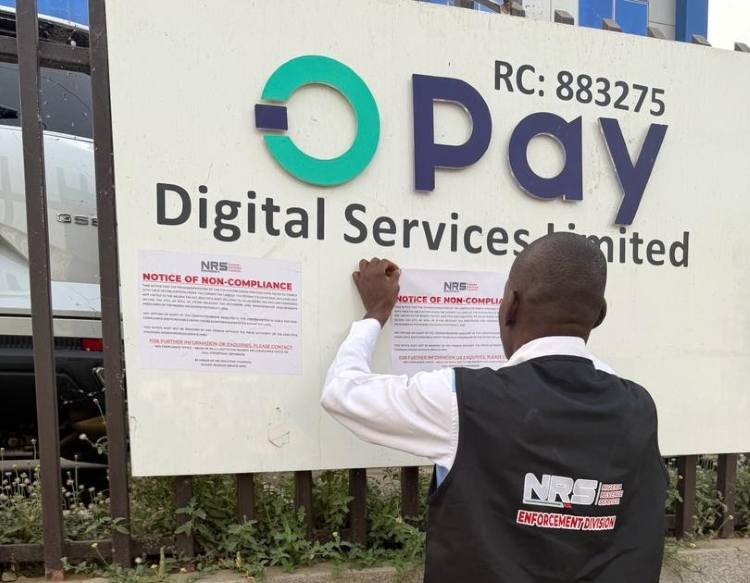

OPay Digital Services Limited has reacted to reports surrounding actions by the Nigeria Revenue Service (NRS) at its offices in Lagos and Abuja.
The clarification comes amid heightened concerns as some of its customers have been engaging in panic withdrawals over fears that the fintech company’s operations may have been disrupted.
Reports and pictorial evidence had surfaced in the media on Wednesday claiming that the NRS sealed OPay’s offices in Lagos and Abuja over alleged failure to comply with Value Added Tax and Company Income Tax obligations under the Nigeria Tax Act 2025.
Following the reports, several Opay customers took to social media platforms to express concern about the safety of their funds, with some indicating that they had begun withdrawing money from their accounts as a precaution.
But Opay, in a statement issued on Thursday, said its operations across the country remain unaffected, stressing that it was only served with a non-compliance notice regarding statutory charges and that this did not impact its nationwide operations.
“Our attention has been drawn to recent reports circulating on online platforms and social media claiming that our offices in Lagos and Abuja were sealed by the Nigeria Revenue Service (NRS) over alleged non-compliance with Value Added Tax (VAT) and Company Income Tax under the Nigeria Tax Act 2025.
“Our offices across Nigeria, including Lagos and Abuja, remain open and fully operational, and we continue to serve our customers, partners, and merchants without disruption.
“As a responsible financial technology company operating in Nigeria, we are compliant with all applicable tax obligations and regulatory requirements. We work closely and transparently with all relevant government agencies and regulatory authorities to ensure that our operations consistently meet statutory standards,” the company’s management said.
OPay explained that the notice referenced in the reports was linked to an industry-wide directive issued by the NRS requiring payment platforms to clearly separate certain statutory charges on their applications to improve transparency and reconciliation.
The firm noted that the directive applied broadly to operators within the digital payments sector.
The fintech company added that it continues to work closely with relevant government agencies and regulators to ensure full compliance with statutory requirements.
It reaffirmed its commitment to supporting Nigeria’s digital economy by delivering secure and inclusive financial services to millions of users across the country.