Politics
2027: North Split Over Peter Obi-Kwankwaso Alliance

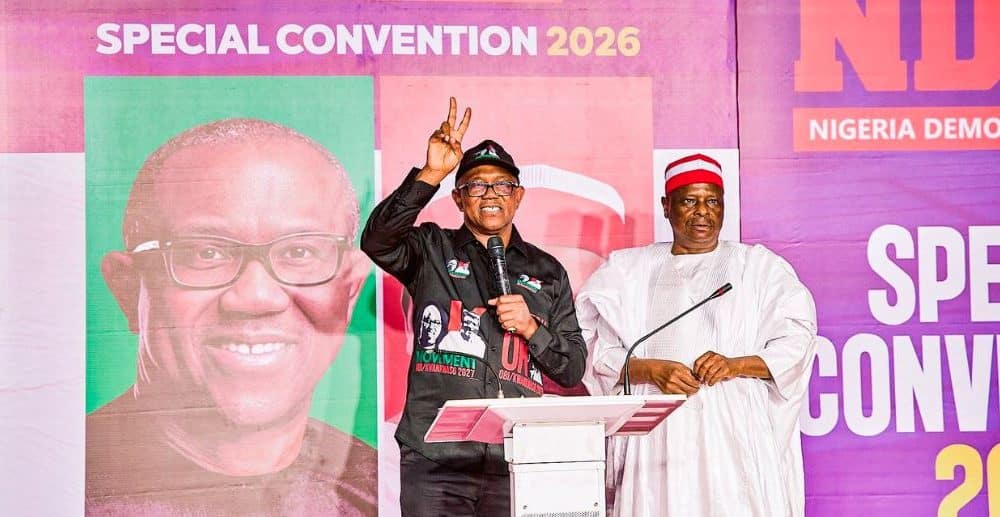
The presidential ambition of Peter Obi, candidate of the Nigeria Democratic Congress (NDC), is facing resistance from some northern political stakeholders and groups, even as supporters insist the party is gaining momentum across the region.
Some stakeholders who spoke to The PUNCH on the issue argued that the NDC has yet to establish strong visibility and acceptance in many northern states.
The National Publicity Secretary of the Arewa Consultative Forum (ACF), Tukur Muhammad-Baba, said the NDC remains largely unknown to many voters across the North.
According to him, while prominent politicians within the party continue to attract attention, their electoral influence remains uncertain.
“It is not necessarily because people dislike the NDC. The party is simply not well known,” he said.
Muhammad-Baba also expressed doubts about the extent of support available to Obi’s running mate, Rabiu Kwankwaso, outside Kano State.
“There is even doubt about whether Kwankwaso can still hold on to Kano, where he recorded his most impressive performance in the last election. Apart from Kano, his influence in many parts of the North remains uncertain,” Muhammad-Baba stated.
“The average northerner is tired of being told that having a northern candidate or a Muslim-Muslim ticket is the solution to Nigeria’s problems. People are becoming more careful because previous expectations have not produced the desired results,” he said.
According to him, political elites and voters are increasingly scrutinising the past statements and actions of opposition leaders and raising questions about their consistency and credibility.
“The average northern elite is asking: where do we go from here? There is confusion and uncertainty. It is not necessarily because people dislike the NDC. The party is simply not well known,” he said.
“In my opinion, the average northern voter is tired of all the political parties without exception. People are no longer impressed by slogans and promises. They want practical solutions to their problems,” Muhammad-Baba added.
The President of the Arewa Youth Consultative Council (AYCC), Zaid Ayuba, also argued that Obi’s candidacy faces challenges among some northern voters.
He claimed that Obi’s perceived position on certain national issues had generated concerns among sections of the electorate.
“Obi and Kwankwaso are known in the North, just like Tinubu and Atiku are known. But politics is different from victory. Obi and Kwankwaso are not accepted in the North in a way that would make one think they will win the 2027 election. In fact, they cannot come close to that.
“A stigma has been trailing Obi’s candidature before his declaration in 2023. He can never be accepted in the North because of two factors. One is that he has openly shown that he is an IPOB sympathiser. Obi had, in several interviews, tried to condemn the Supreme Court judgment on the proscription of IPOB and its designation as a terrorist organisation.
“There are people from other parts of this country who try to make northerners look as if they are terrorist sympathisers. But that is not true. No reasonable northerner or authority came out to sympathise with Boko Haram leaders like Muhammad Yusuf or Shekau,” he said.
A political science professor in Sokoto, who requested anonymity, said the NDC still lacks strong structures in several northern states.
According to him, the party is yet to establish the kind of presence enjoyed by the APC, PDP and ADC in many parts of the region.
“It is a question of visibility. The NDC is a completely new party as far as party politics in Nigeria is concerned,” he said.
The Northern Youth Assembly accused Kwankwaso of abandoning northern political interests through his alliance with Obi.
In a statement signed by its Secretary-General, Hafiz Garba, the group argued that the alliance did not reflect the values historically associated with the Kwankwasiyya movement.
“Kwankwaso’s ultimate betrayal is not the betrayal of a party, a platform or a political alliance. His ultimate betrayal is the betrayal of the idea that northern Nigeria could produce a political leader whose commitment to the region’s dignity, history and cultural identity was not merely performative but genuine.
“Kwankwaso now stands as the leading political embarrassment and disappointment of the northern region and the ideology for which our forefathers built the region and died for.
“Northern Nigeria’s people deserve leaders who place their interests, dignity and advancement at the absolute centre of every political calculation,” the statement added
However, party officials and supporters rejected claims that the NDC lacks acceptance in the North.